Buying a villa to renovate in Marbella opens the door to locations and plots that rarely come up in new developments. It also makes it possible to create a home tailored to the buyer, rather than accepting a developer's decisions.
But an older house is not automatically an opportunity.
The deal only makes sense when the quality of the original asset, the permitted transformation, the total cost and the end value are consistent with one another. The asking price is merely the first piece of information.
The first question is not how much the renovation costs
Before costing materials, kitchens or finishes, you need to establish what you are really buying.
With a villa, much of the value may lie in elements that no building work can reproduce:
- The exact position within the area.
- The size and shape of the plot.
- The orientation and views.
- Privacy from neighbouring properties.
- Access, noise and gradient.
- Genuine proximity to schools, the beach, golf and amenities.
- The available buildable area.
A dated house on a good plot can justify a major intervention. A cheap house on a poorly oriented plot, exposed to traffic or with difficult topography, may still be a bad purchase after renovation.
Architecture can be changed. The micro-location and the plot's limitations cannot.
Check what can be transformed
Buyers should distinguish between three possibilities:
- Updating the existing house. The structure and main layout are retained, with work focused on services, finishes, kitchen, bathrooms, joinery and outdoor areas.
- Renovating and reconfiguring. The work changes circulation, openings, the relationship with the terraces or the position of certain rooms. It may affect the structure and services and require a more complex approval process.
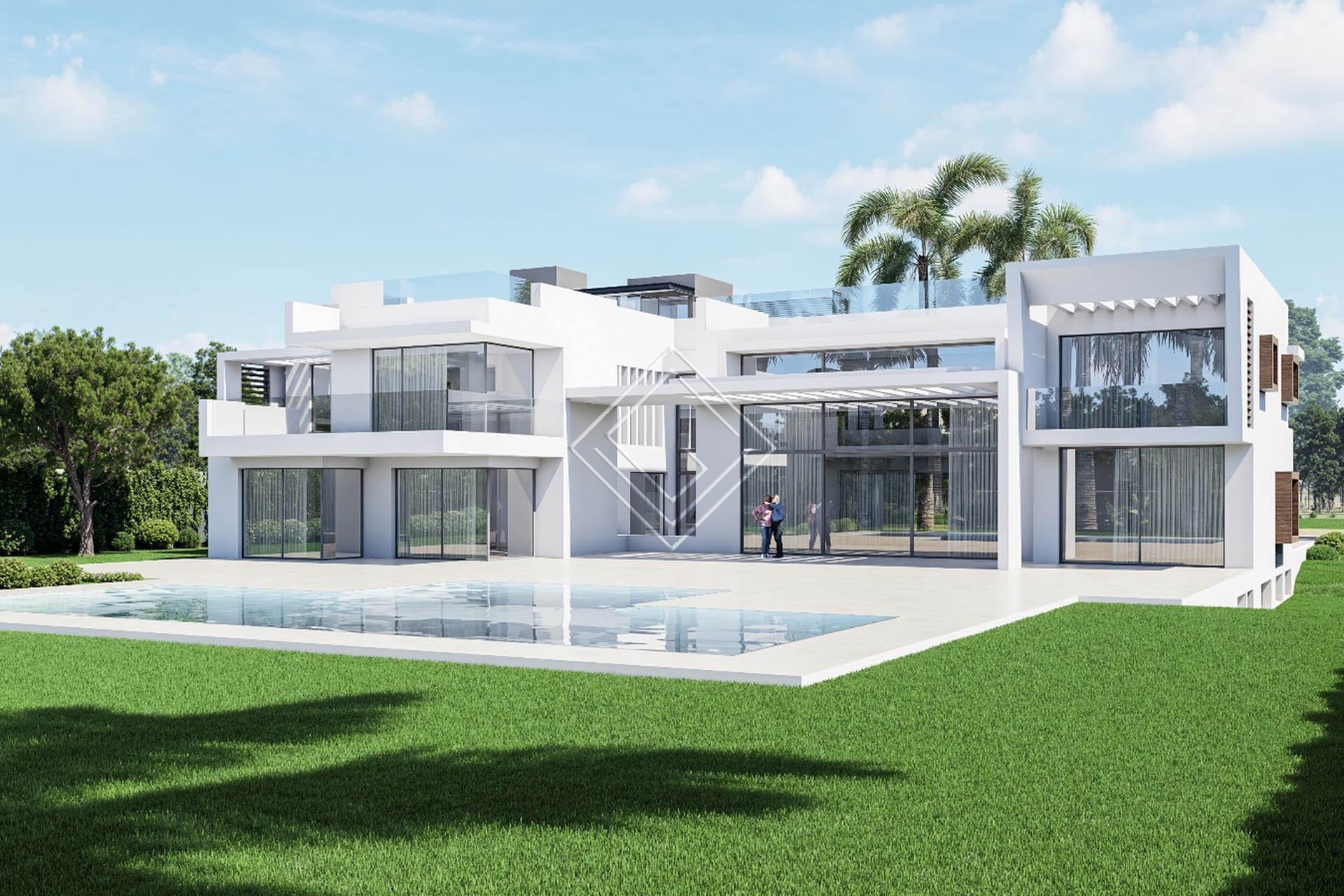
- Extending or replacing the building. The aim is to increase floor area, change the volume or demolish and build a new villa. In this case, feasibility depends directly on the planning framework and the plot's planning status.
You should not assume a house can be extended simply because the plot is large. Buildable area, site coverage, setbacks, height, topographical conditions and applicable regulations must be analysed together.
You should also check whether pools, porches, basements, covered terraces or previous extensions are properly documented.
As we explain in our guide to registered, cadastral and actual floor area, the three descriptions may not match and each serves a different purpose.
What an architect should review before purchase
A technical inspection does not replace the lawyer's legal review. Nor is it limited to spotting cracks or damp.
Its purpose is to understand the property, identify risks and establish an initial strategy for the work. Depending on the property, it is worth reviewing:
- The structure and any deformation or cracking.
- Roofs, terraces and waterproofing.
- Damp caused by leaks, condensation or contact with the ground.
- The condition of façades, external walls and windows.
- Electrical installations, plumbing and drainage.
- Air conditioning, ventilation and hot water.
- The pool, walls, gardens and drainage systems.
- How the current layout fits the intended use.
- An initial match between what has been built and the available documentation.
A visual inspection cannot guarantee how every concealed element will perform. It does make it possible to detect warning signs, decide what further tests are needed and avoid basing the budget solely on how the house looks.
The budget must include more than the building work
The usual mistake is to add the purchase price to a generic renovation estimate.
The real cost of transformation is broader:
Total cost = purchase + taxes and fees + design and technical consultants + licences and fees + construction + outdoor works + fittings + contingency + financial and time costs.
With villas, the garden, pool, walls, utility connections and outdoor installations can account for a significant share of the investment.
The kitchen, lighting, built-in joinery, home automation, furniture and landscaping should also be factored in if the goal is a finished home.
The contingency should not be used to disguise an incomplete budget. It is there to absorb reasonably unforeseeable circumstances, not items that should have been studied from the outset.
Time is also part of the investment
A renovation does not start immediately after purchase.
Before that, you may need a survey of the house, a planning analysis, the design, coordination of specialists, the licence application, appointment of the contractor and selection of materials.
The schedule will depend on the scope of the work and the corresponding approval process. An interior update and a structural extension should not be assessed against the same timescale.
This has practical consequences. Buyers should consider how long they will be unable to use the home, what costs they will continue to bear during the works and how much leeway there is for delays in decisions, supplies or execution.
How to estimate the value of the finished villa
The end value is not obtained by automatically adding the cost of the renovation to the purchase price.
The resulting home must be compared with genuinely equivalent properties in terms of area, plot, floor area, orientation, views, privacy, technical quality and condition.
Asking prices help to understand the market, but on their own they do not prove the closing value.
What is more, two renovations with similar budgets can produce very different commercial results. The market tends to reward decisions that correct the property's structural problems:
- Improving natural light.
- Rationalising the layout.
- Connecting indoors and outdoors.
- Creating well-proportioned bedrooms.
- Resolving awkward circulation.
- Fully updating the services.
- Making the most of the views and protecting privacy.
An accumulation of expensive materials does not fix a poor floor plan or a weak relationship with the plot.
The calculation to make before submitting an offer
A renovation deal can be analysed through a simple sequence:
- Make a prudent estimate of the value of the finished home.
- Subtract all acquisition and transformation costs.
- Add a contingency proportionate to the level of uncertainty.
- Consider the time required and the risk taken on.
- Arrive at the maximum purchase price compatible with the objective.
This calculation is useful both for those looking for a home of their own and for those seeking a return.
In the first case, it shows whether personalisation justifies the effort compared with buying a finished house. In the second, it avoids mistaking an apparent discount for a real margin.
An example in Lomas de Marbella Club
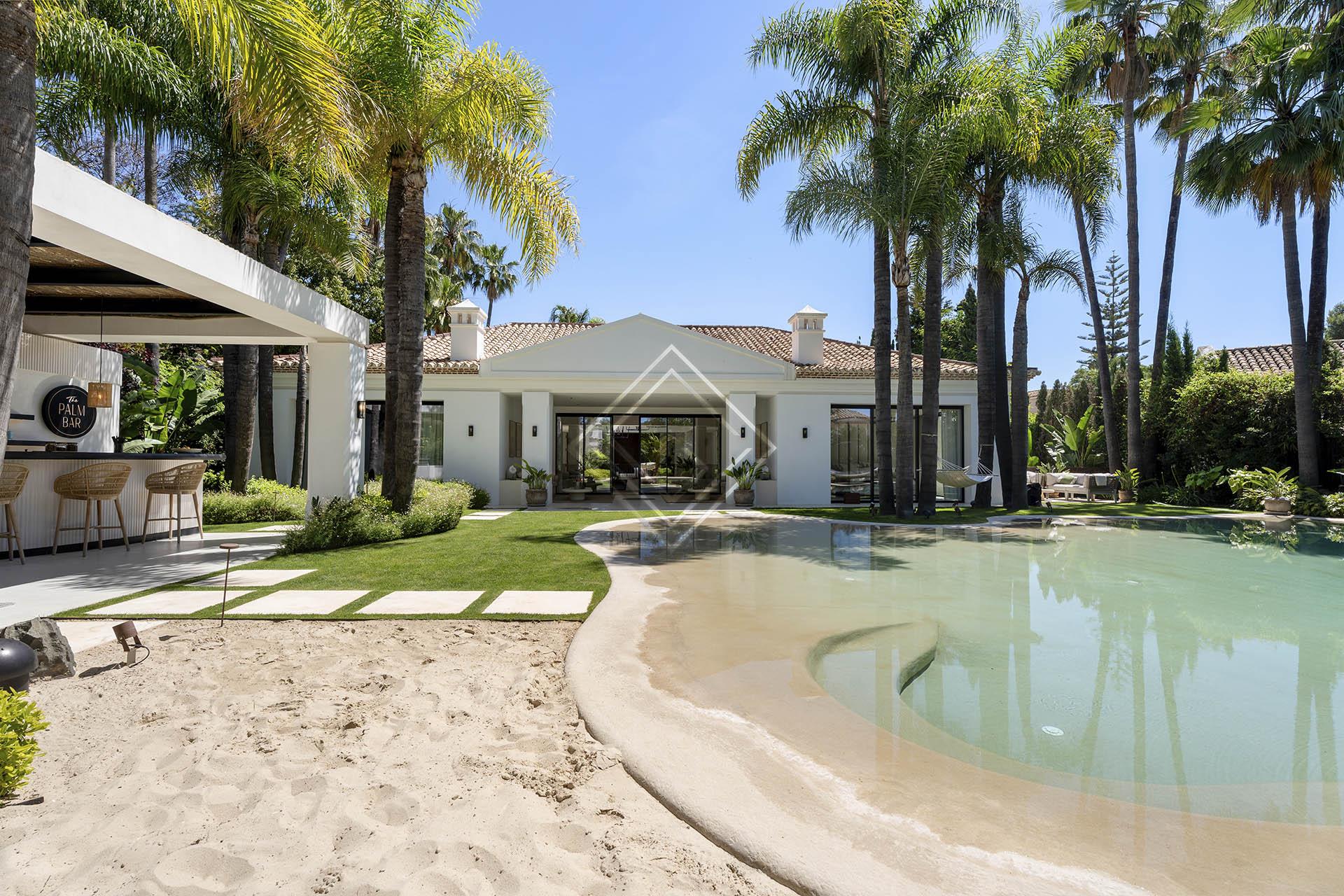
The villa with a large plot in Lomas de Marbella Club illustrates the type of asset that calls for this kind of analysis.
The property combines two adjoining plots totalling 2,181.23 m² and a Mediterranean villa with 459 m² of built area.
Its appeal lies not only in updating the existing house. The listing identifies available buildable area, which makes it possible to explore a renovation with an extension, always within the applicable planning parameters and subject to obtaining the corresponding design and licence.
In a deal like this, the buyer should not simply compare the price per square metre of the current house.
They need to assess the land, the position, the existing built area, the planning potential, the cost of transformation and the value of a finished villa on a plot of that scale together.
When to walk away from the deal
A villa to renovate no longer makes sense when:
- The main weakness lies in the location rather than the house.
- The necessary extension is not viable in planning terms.
- The existing structures carry uncertainties that are hard to resolve.
- The total budget approaches the price of a better, finished home.
- The timescale does not suit the buyer's needs.
- The expected end value relies on overly optimistic comparables.
- The work tries to force onto the plot a house it cannot properly accommodate.
Ruling out a property after analysis does not mean the study has failed. It means it has done its job before any capital was committed.
Buying a villa to renovate with technical judgement
The opportunity does not lie in buying an old house. It lies in recognising a good plot, understanding what transformation it allows and paying a price that is compatible with the cost and risk of the project.
At GV Marbella we analyse properties from both a real estate and an architectural perspective. Before recommending a villa to renovate, we study its position, documentation, condition, potential and relationship with the market for finished homes.
If you are considering a deal of this kind, you can contact GV Marbella to compare the existing house, the reasonable scope of work and the available alternatives before making an offer.
The information in this article is for guidance only and is not contractually binding. Planning, technical, legal and financial feasibility must be verified specifically for each property.